# HumanLayer - All Resources
Dex · September 4, 2026 · < 15 min read
A chronology of HumanLayer's writing and talks:
- 1.9M combined YouTube views
- 3.4M combined X views
- 5 front-page Hacker News posts with 2,539 points and 1,177 comments
We break the content into several eras, each representing a substantial evolution in how we think about AI and agents.
- Aug 2026-present: The future of software factories must be open and composable
- May-July 2026 - Software Factories: Design Patterns and Failure Modes
- February-May 2026 - From RPI to QRSPI, and the crusade against slop
- October-January 2025 - No Vibes Allowed and the Early Days of Ralph Wiggum
- July-September 2025 - Context Engineering for Coding Agents
- April 2025 - 12-Factor Agents and the Birth of Context Engineering
Reminder - The best way to experience these best practices is to try HumanLayer - it's free for teams up to 3, and is already helping teams with 100s of engineers ship fast in large codebases without descending into a chaotic slop-fest.
## Aug 2026-present: The future of software factories must be open and composable
As we spend more time with enterprises building their own software factories, we talk about the design patterns and architecture, and we look at what a new ai-native forge / system of record looks like - combining code, artifacts, and agent sessions in one multiplayer workspace.
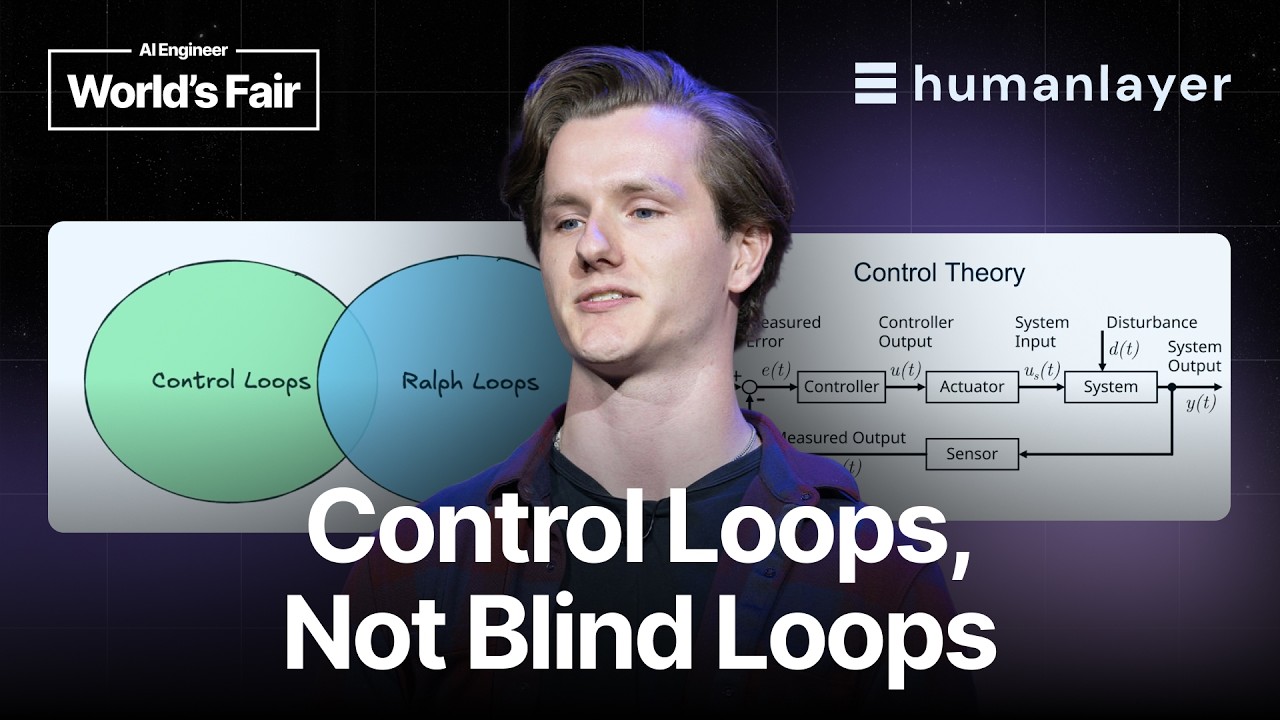 Loops Engineering from First PrinciplesKyle Mistele shows how sensors, controllers, and small checked changes make agent loops safe to run.
 AI That Works: Software Factory Design PatternsA real factory built from loops that find bugs, open issues, draft fixes, review changes, and learn.
## May-July 2026 - Software Factories: Design Patterns and Failure Modes
The harness is only one part of a software factory. We set out its failure modes: one-shot tests, token use, and task count do not measure whether code stays easy to change. We then described the building blocks teams need to build better factories: composable compute, development environments, harnesses, sessions, plans, artifacts, review, and human control.
### Why Software Factories Fail
And what to do about it
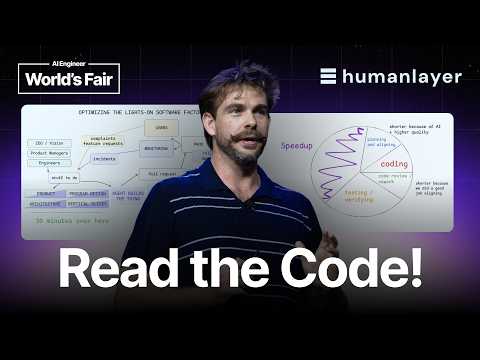 AI Engineer Keynote: Why Software Factories FailThe case against lights-off software factories, and a four-step path to fast, maintainable AI-written code.
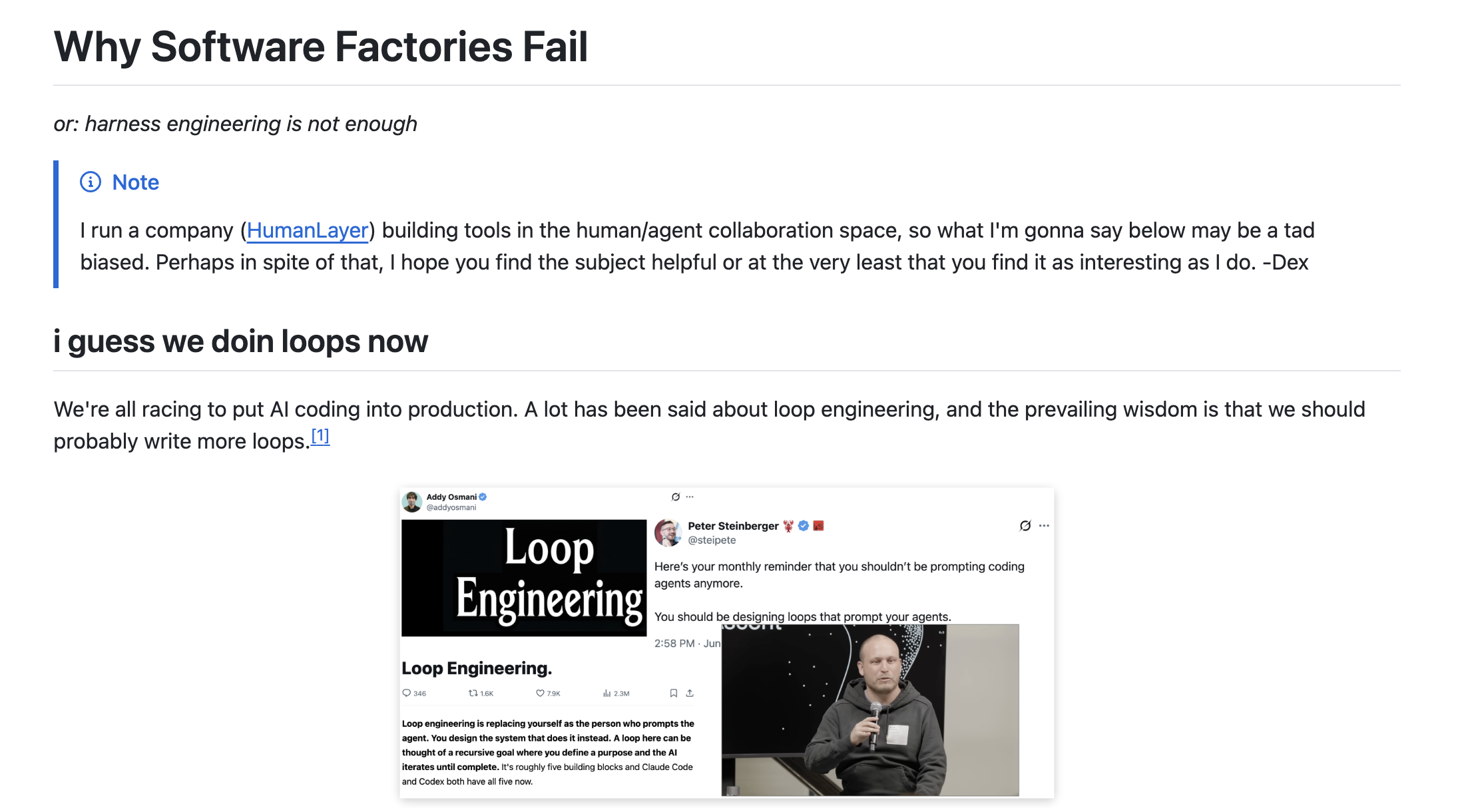 Why Software Factories Fail on GitHubThe full argument for why passing tests cannot reward maintainability, and where human review still matters.
 Hacker News discussionThe community debate on whether harnesses can solve model limits around long-term code quality.
The same post was published as a two-part X article
 X article, part 1: The Harness Is Not EnoughWhy model training rewards passing tests but does not penalize choices that make code harder to change.
 X article, part 2: Turning the Lights Back OnHow product review, system design, program design, and vertical slices cut rework before code review.
Other interviews on our journey to get here
 The Pragmatic Engineer interviewDex and Gergely Orosz trace context engineering, harnesses, loops, and the shift toward software factories.
 David Ondrej: Agentic Engineering WorkflowA long-form walkthrough of Dex's current workflow for planning, steering, and reviewing agent-written code.
### Proving the slop code problem
"Why software factories Fail" posits that models can't write maintainable code - SlopCodeBench Proves it
 X article, part 3: Benchmarking the New FrontierA short case for tests that measure whether agents can keep changing one codebase without degrading it.
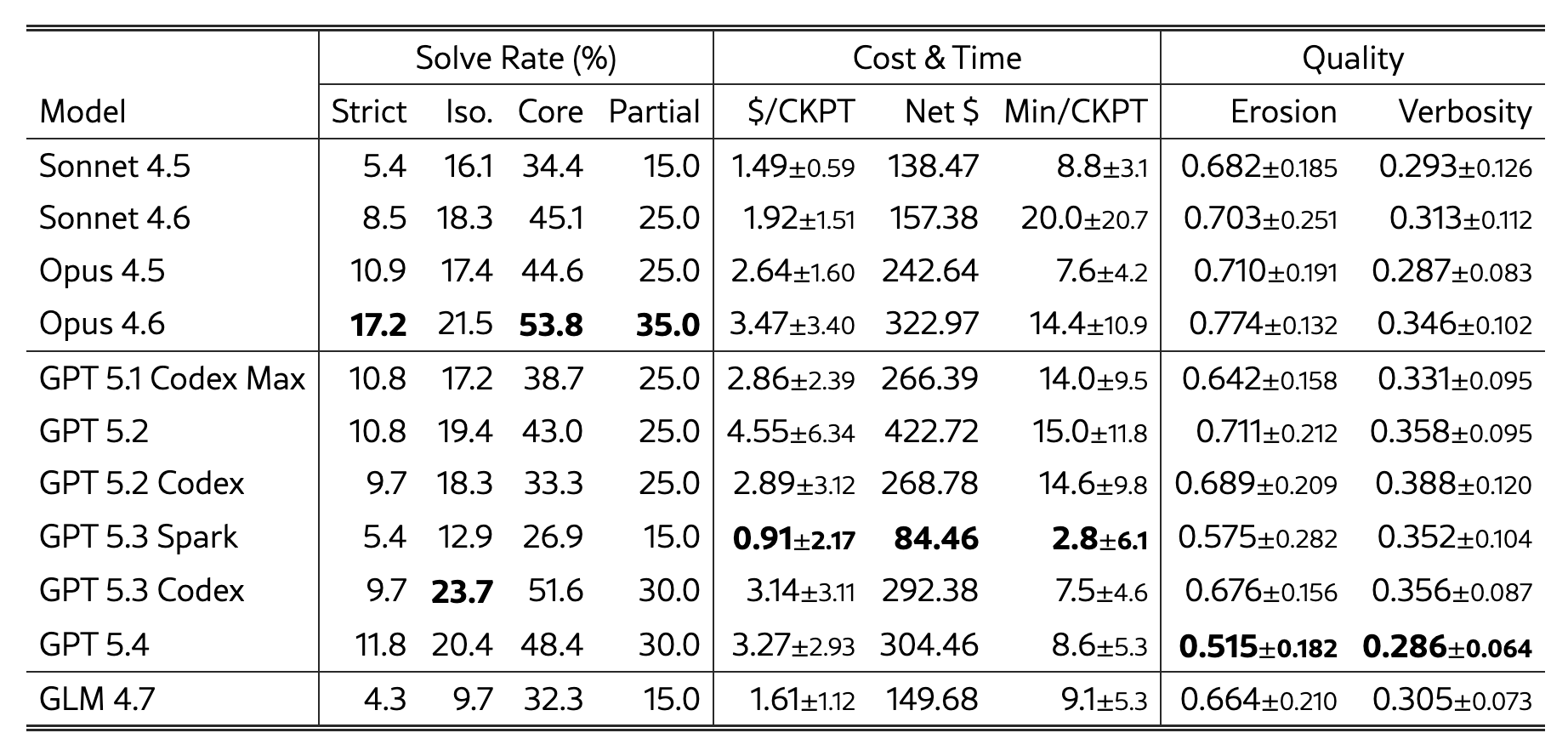 SlopCodeBench: Opus 5 benchmark reportOpus 5 passed 4 of 17 checkpoints while every model added defects and more complex code over time.
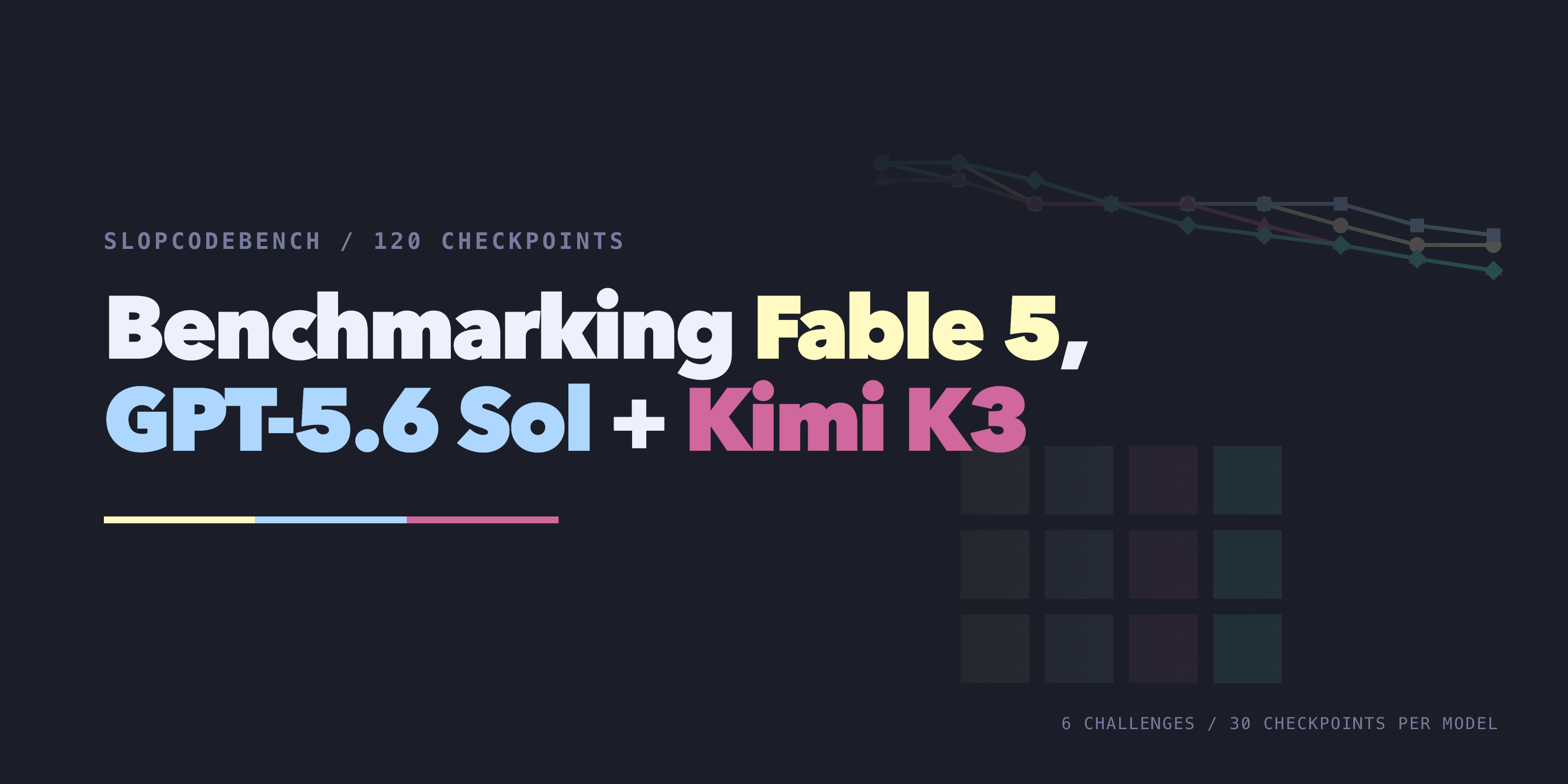 SlopCodeBench: Sol, Fable, and Kimi benchmark reportFable and Sol tied at 33.3% on a larger run; all four models still built up defects across checkpoints.
 AI That Works: SlopCodeBenchA tour of an eval that reveals requirements in stages and checks whether agents preserve working code.
 Hacker News discussionThe community review of the Opus 5 run, its 24% strict pass rate, and the benchmark itself.
 Frontier AI Coding BenchmarksA deep dive on state-of-the-art benchmarks that came before SlopCodeBench.
### Other content from this era
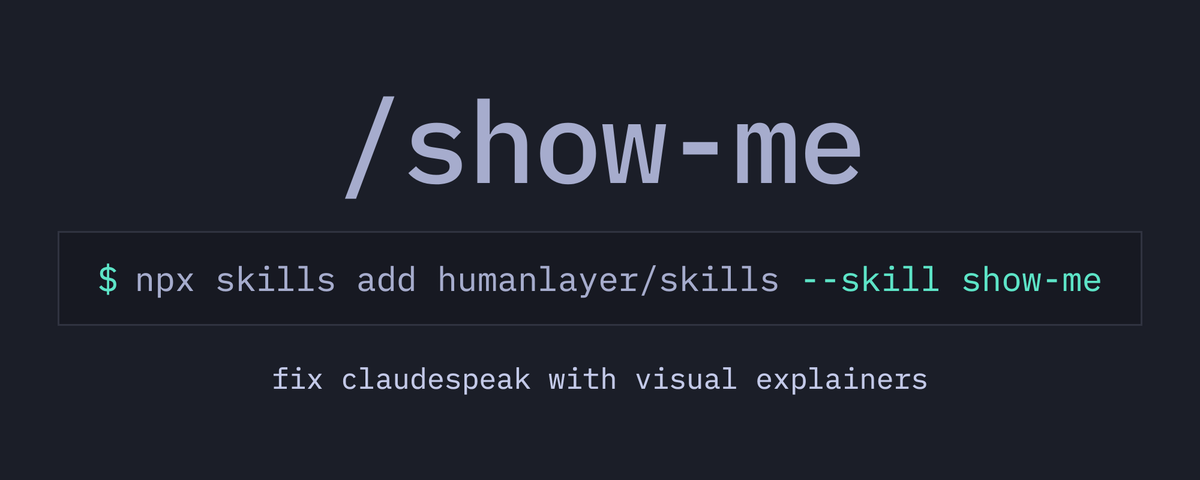 /show-me: Visual Explanations for Coding AgentsA skill that asks agents to explain code, plans, and diffs with compact diagrams instead of long prose.
 HumanLayer Live Demo: Building a Product Spec for compounding agent memoryDex and Vaibhav design a shared memory system that turns repeated team guidance into reviewed agent context.
 Pragmatic Leverage in the Software FactoryWhy a little planning removes most expected rework, while polishing every detail up front wastes time.
 HumanLayer launch videoThe case for a coding environment built around human review, control, and code quality.
 AI That Works: Building Your Own Software FactoryA practical map of the parts teams need to compose reliable coding-agent systems.
## February-May 2026 - From RPI to QRSPI, and the crusade against slop
After running a lights-off factory for five months and getting drowned in unmaintainable slop, we took a step back, reset, and revised our advice: read the code, seek leverage, and break skills into workflows. It was time to drink our own context-engineering Kool-Aid.
### From RPI to QRSPI
The RPI to QRSPI saga captures our learnings rolling out the Research/Plan/Implement framework to hundreds of engineers, and how to move fast without descending into slop.
 Lessons Learned Rolling Out RPI to Hundreds of EngineersFive months of field lessons led from giant RPI prompts to smaller workflows with more structure and human ownership.
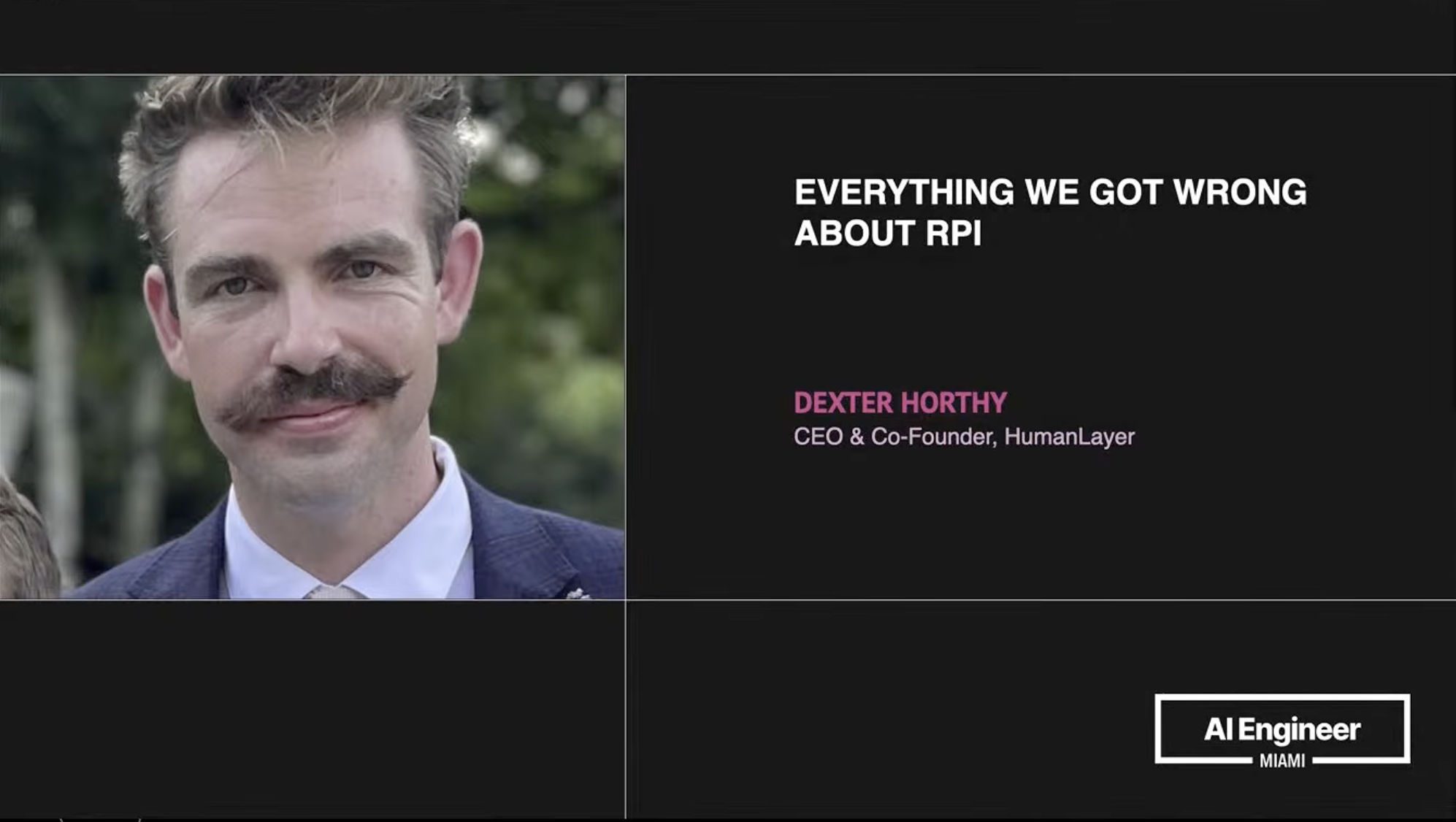 Everything We Got Wrong About Research-Plan-ImplementDex explains why RPI became a way to outsource thought, and how QRSPI turns it into explicit control flow.
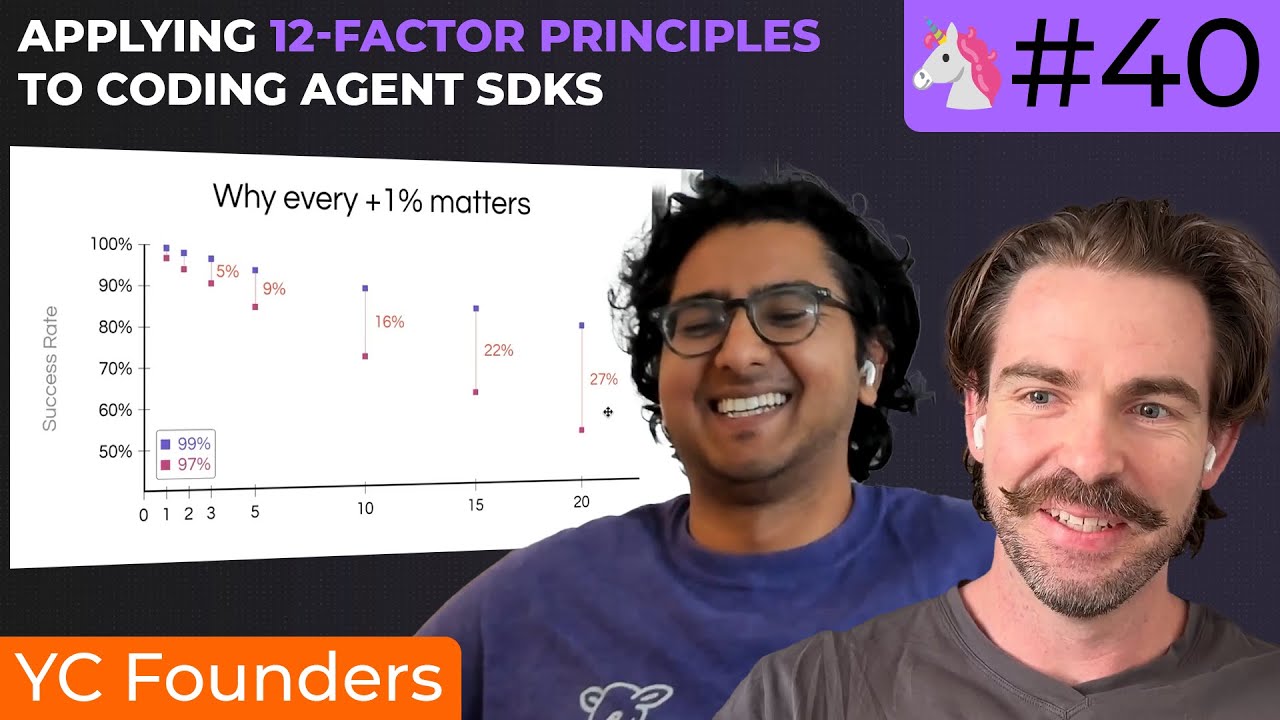 AI That Works: Applying 12-Factor Principles to Coding Agent SDKsWhy reliable agents need explicit state, planning, failure recovery, and production tooling.
### Agentic Backpressure and Harness Engineering
We spend some time going deep into techniques that help agents check their own work, so they can work unattended for longer
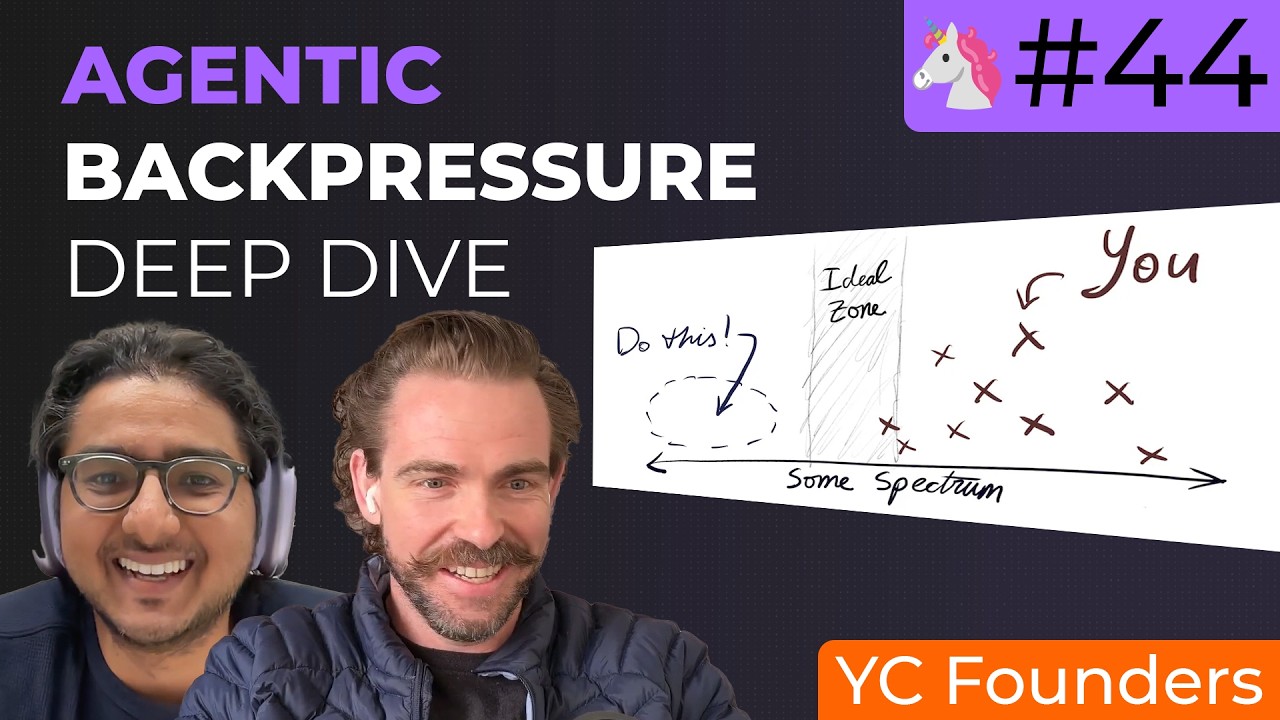 AI That Works: Agentic Backpressure Deep DiveHow learning tests and deterministic checks help agents test assumptions and recover from bad paths.
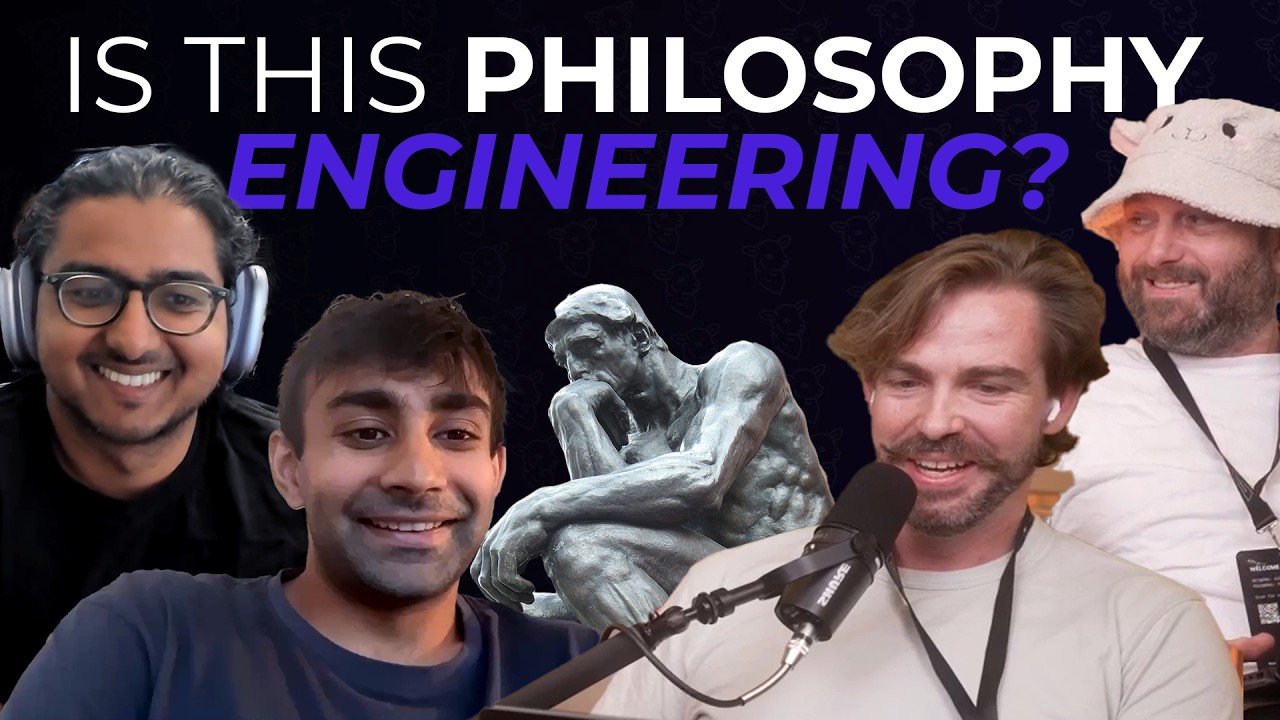 AI That Works: Harness Engineering Without the HypeDex, Vivek Trivedy, and Geoffrey Huntley separate useful harness work from hype around agent systems.
### Other Content from this era
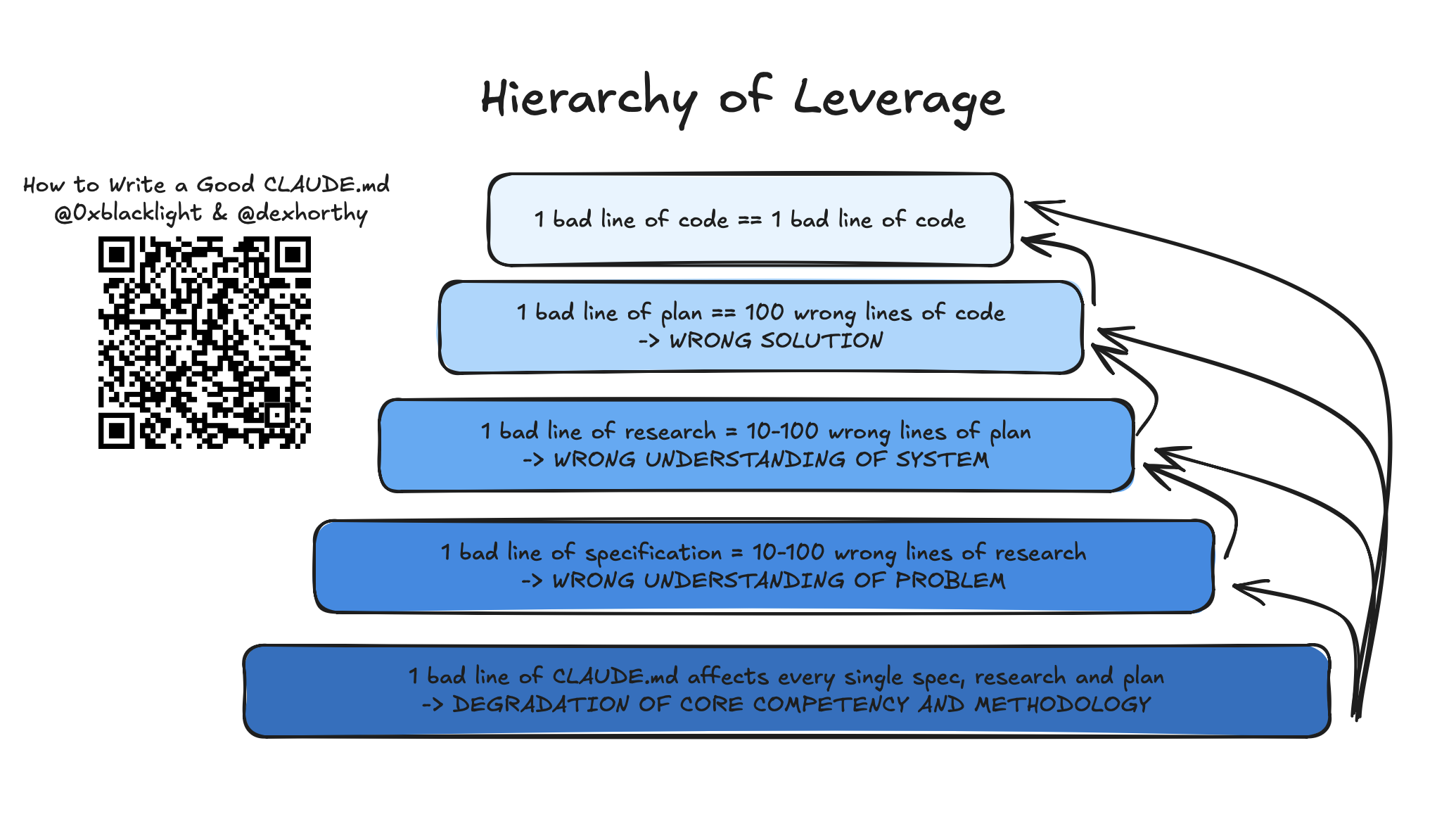 Writing a Good CLAUDE.mdHow concise, broadly useful instructions and progressive disclosure help coding agents follow repository guidance.
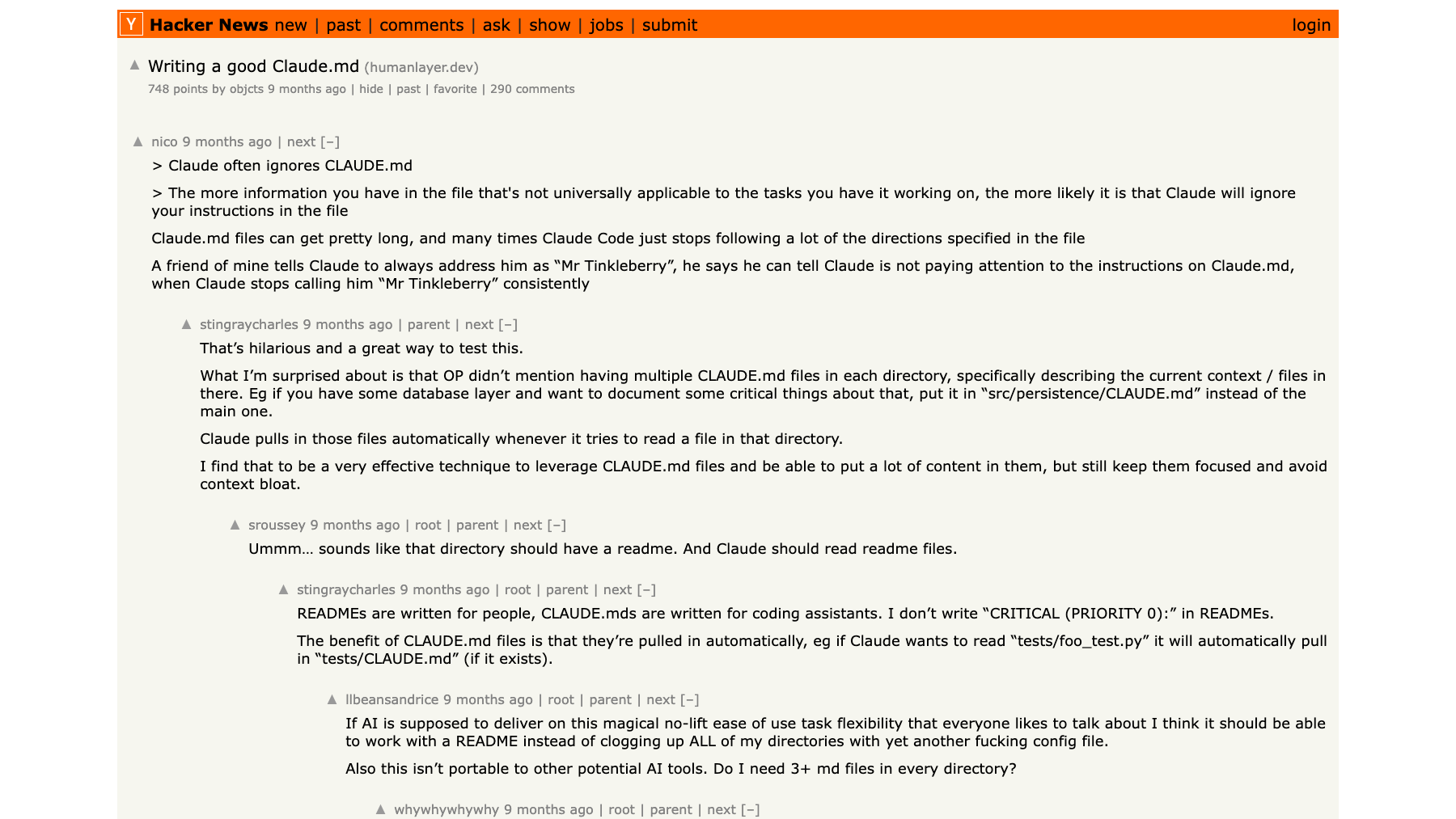 Hacker News discussionThe community debate over whether CLAUDE.md files help agents follow instructions or add more noise.
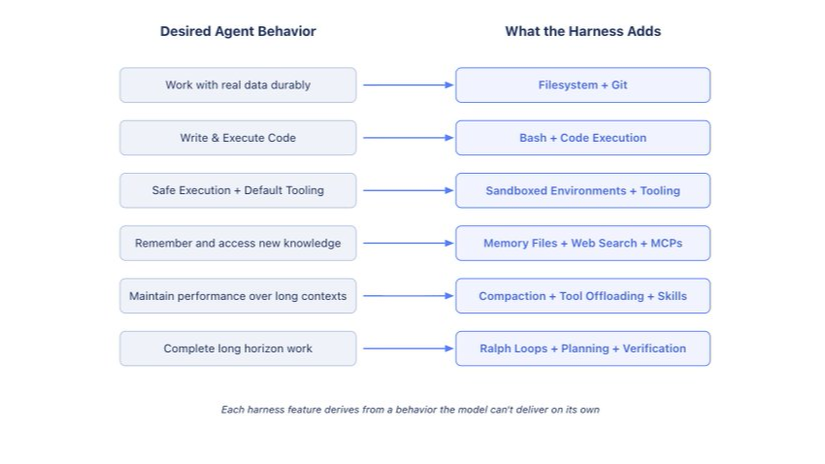 Skill Issue: Harness Engineering for Coding AgentsHow agentfiles, tools, skills, subagents, hooks, and backpressure improve output without waiting for new models.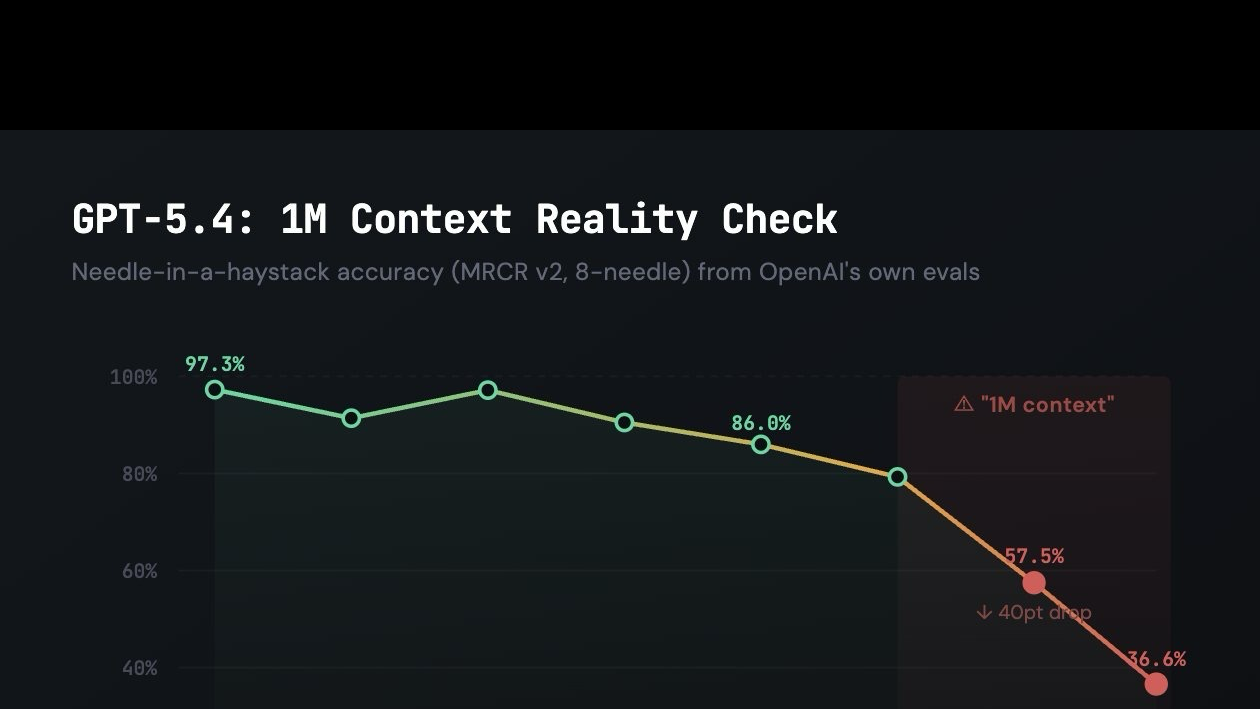
## October-January 2025 - No Vibes Allowed and the Early Days of Ralph Wiggum
Strong AI coding should look like disciplined engineering: refine the task, research the code, agree on a plan, implement in phases, and read the result. Loops such as Ralph can scale the work, but only when teams give them sound context and clear checks.
### No Vibes Allowed
No Vibes allowed was the talk that swept the entire agentic coding practice. Over 600k youtube views - the polished articulation of how to apply context engineering principles to the usage of coding agents. We covered why "spec-driven-dev" is the wrong way to think about the problem, and went deep on HumanLayer's OSS Research / Plan / Implement framework.
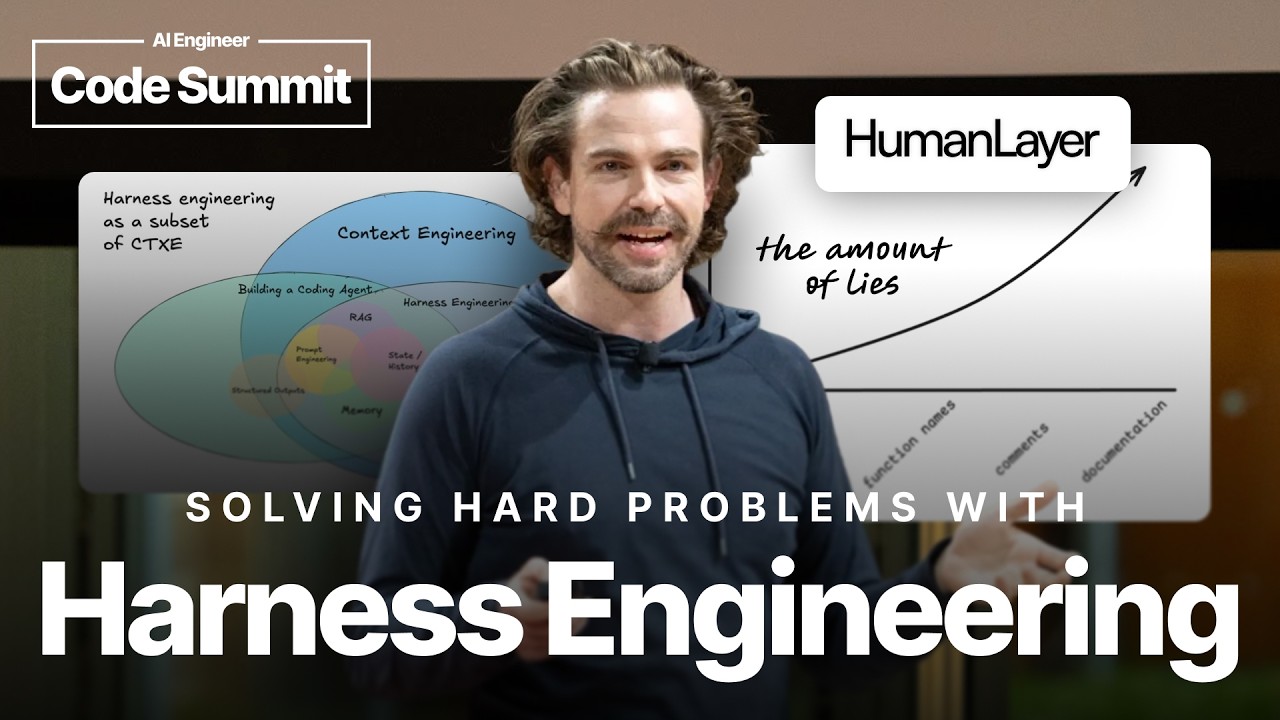 No Vibes Allowed: Solving Hard Problems in Complex CodebasesHow frequent intentional compaction, research, plans, and human review let today's agents handle hard production work.
 No Vibes Allowed: Live Coding with AI AgentsDex and Vaibhav take timeout support through specification, codebase research, planning, and phased implementation.
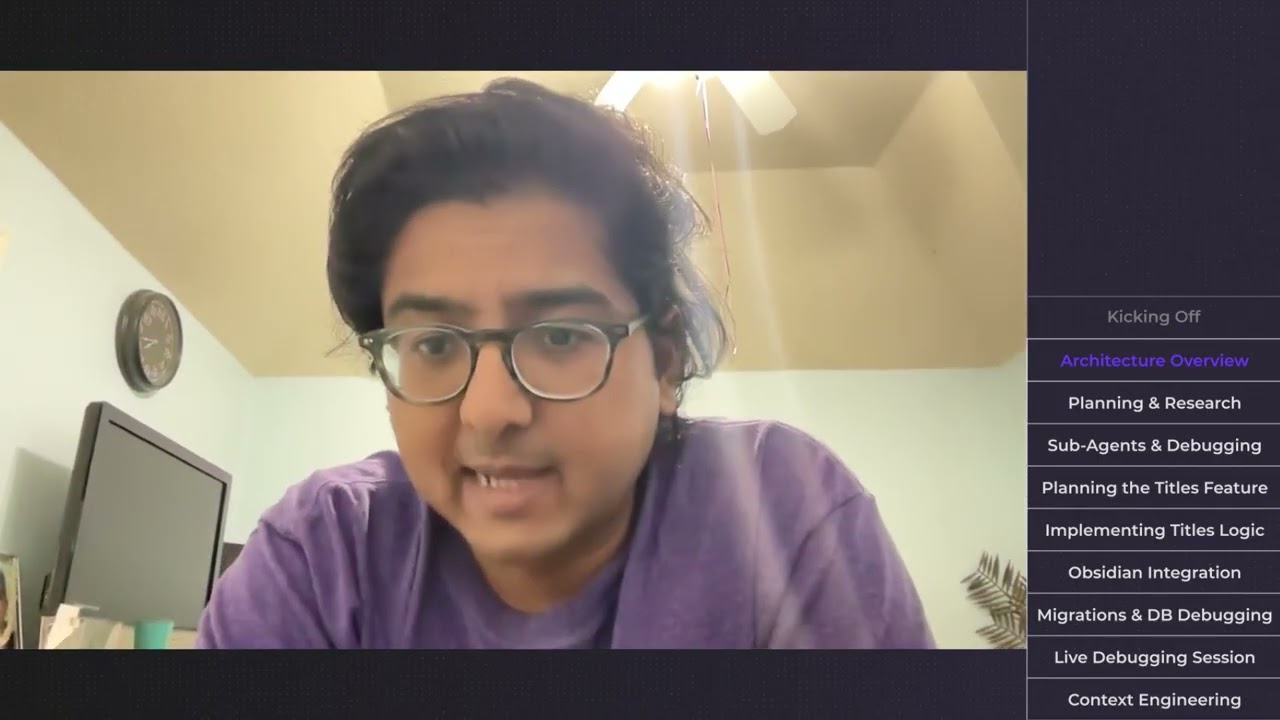 No Vibes Allowed: Using CodeLayer to Build CodeLayerA dogfooding session that uses RPI, subagents, migrations, and live debugging to ship features in CodeLayer itself.
### The Early Days of Ralph Wiggum
 A Brief History of RalphDex traces Ralph from a five-line bash loop through refactors, spec generation, viral adoption, and the limits of unattended runs.
 Ralph Wiggum Under the Hood: Coding Agent Power ToolsGeoffrey Huntley, Dex, and Vaibhav explain how Ralph uses fresh context and simple loops for specs, refactors, and new projects.
 Ralph Wiggum Showdown with Geoffrey HuntleyA direct comparison of the original bash loop and Anthropic's plugin, with live examples and a focus on context control.
### Ideas from this era
## July-September 2025 - Context Engineering for Coding Agents
Context engineering became a practical way to make coding agents work in large, existing codebases. The method was frequent intentional compaction: split work into research, planning, and implementation; keep each context focused; use subagents to isolate search; and put human review before the steps where a bad assumption gets costly.
The YC talk drew more than 200k views, the companion essay reached the front page of Hacker News, and HumanLayer reached #1 on GitHub Trending. Getting good results from coding agents is not a prompt trick. It is an engineering practice built around context, workflow, and well-placed human judgment.
 Advanced Context Engineering for AgentsThe YC talk on spec-first workflows, frequent intentional compaction, subagents, and human review for getting today's models to work in complex codebases.
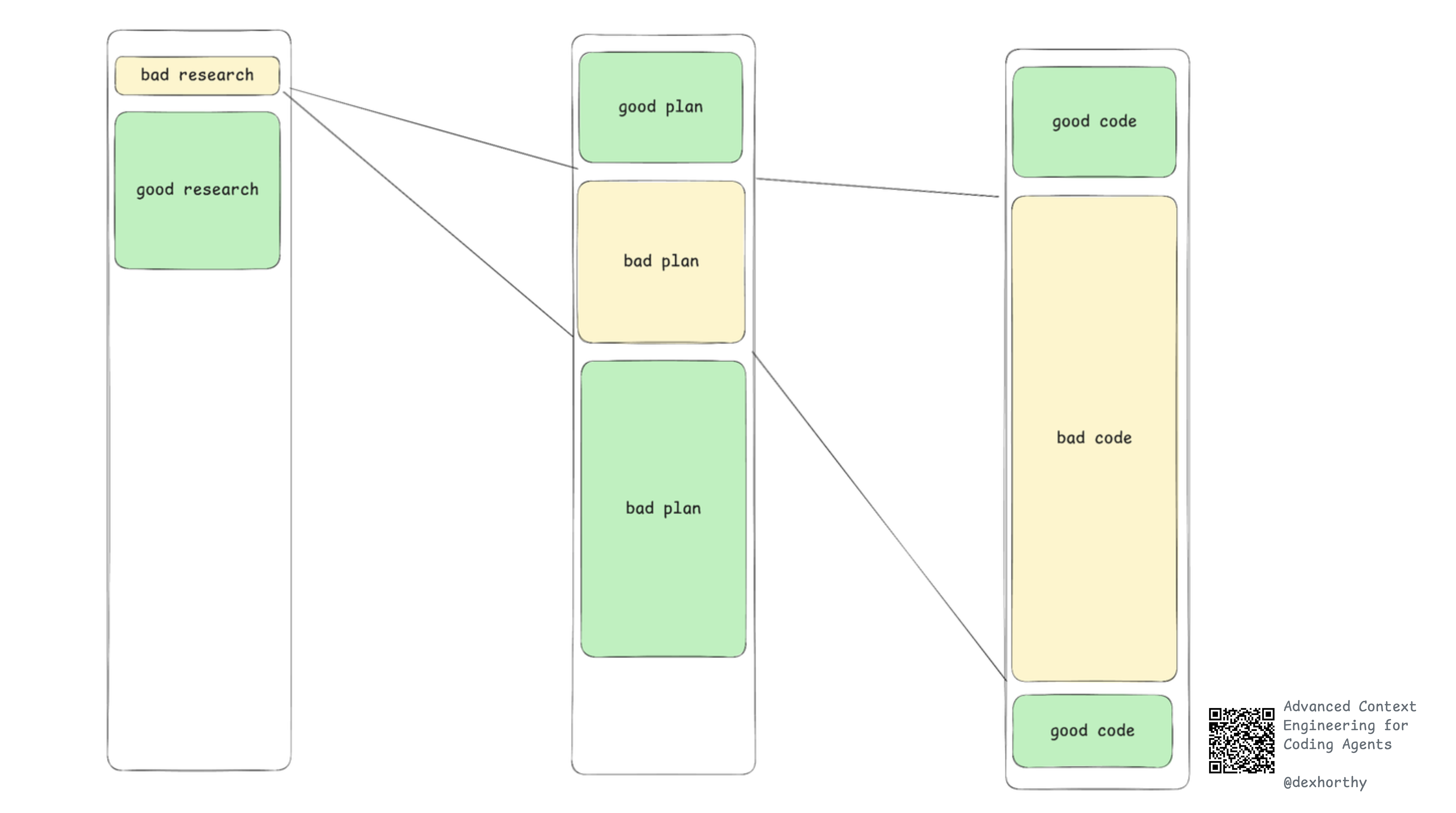 Getting AI to Work in Complex CodebasesA field report from work in a 300k-line Rust codebase on research-plan-implement, keeping agent context focused, and reviewing the artifacts with the most leverage.
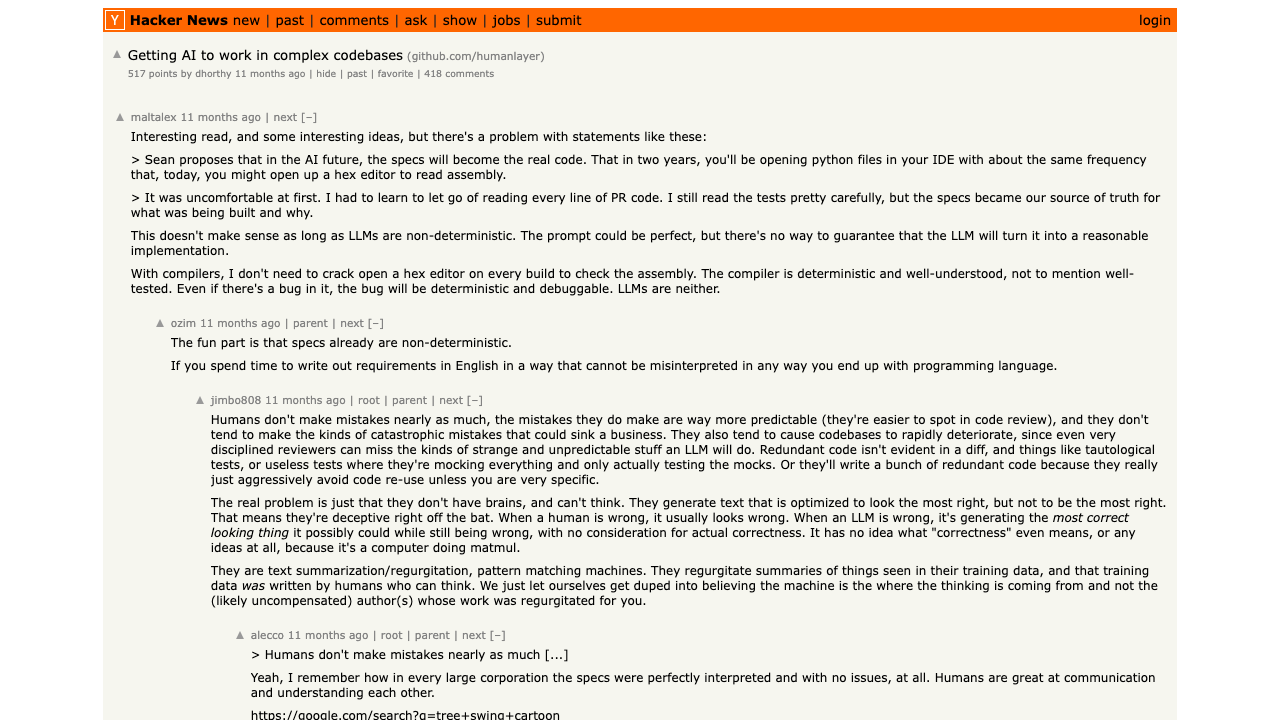 Hacker News: Getting AI to Work in Complex CodebasesA deep debate over specs as a source of truth, model uncertainty, compaction, and whether agent workflows can scale to real production systems.
### Ideas that followed
- The triple pendulum of context management in Claude subagents
- Intentional understeering in AI interactions
- Coding agents don't use frameworks
- The right UX for subagents
- Brownfield vs. greenfield AI development
- Aaron Levie shouts out Advanced Context Engineering
- HumanLayer reaches #1 on GitHub Trending
## April 2025 - 12-Factor Agents and the Birth of Context Engineering
We introduced the term context engineering to describe what strong production AI builders were already doing: owning and shaping the full set of information available to a model at each step. 12-Factor Agents turned those practices into clear rules for building reliable LLM software.
The starting point was simple: the best production agents were mostly well-engineered software with LLMs used at a few key points. Instead of handing the whole system to an agent framework, builders should own the prompts, context, state, control flow, error handling, and human contact points themselves.
Factor 3 named the core discipline: everything is context engineering. Models are stateless functions, so the quality of each next step depends on the information, instructions, history, and tools assembled for that call. That idea became shared language across the AI industry over the months that followed.
### The original field guide
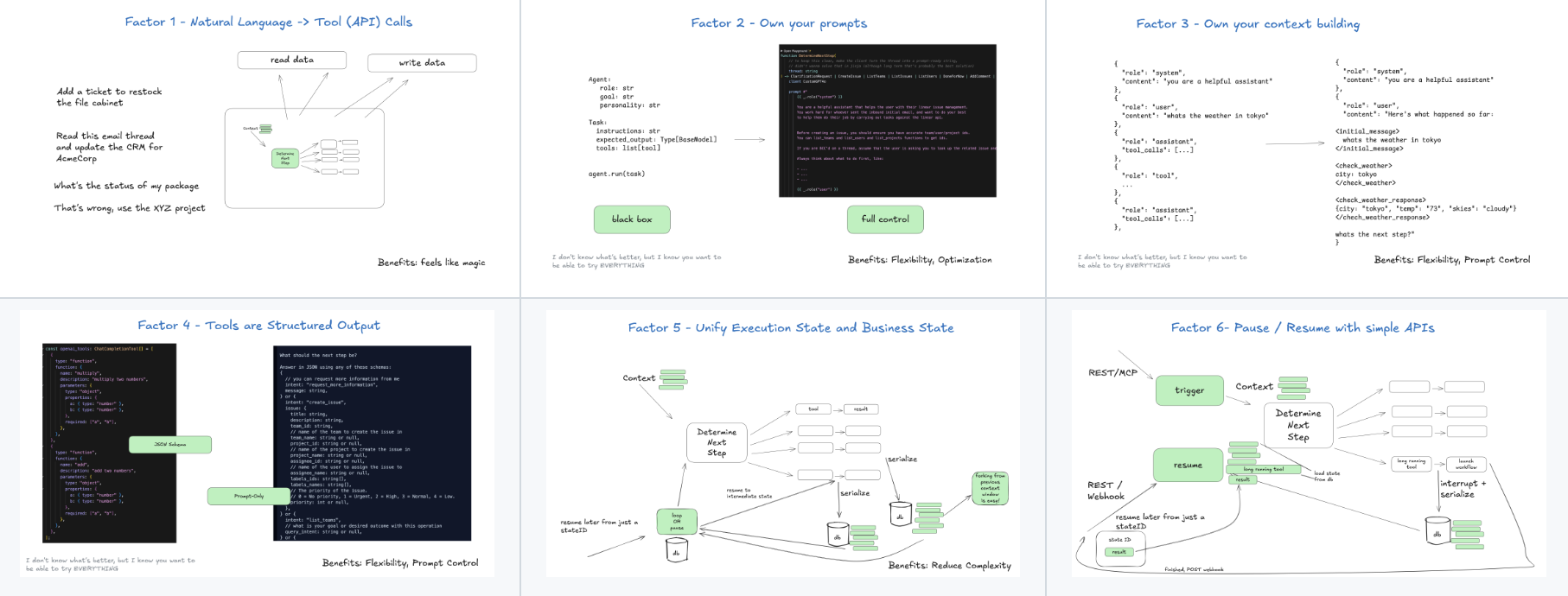 12-Factor AgentsTwelve principles for reliable LLM software: own prompts and context, keep control flow explicit, unify state, compact errors, and build small focused agents.
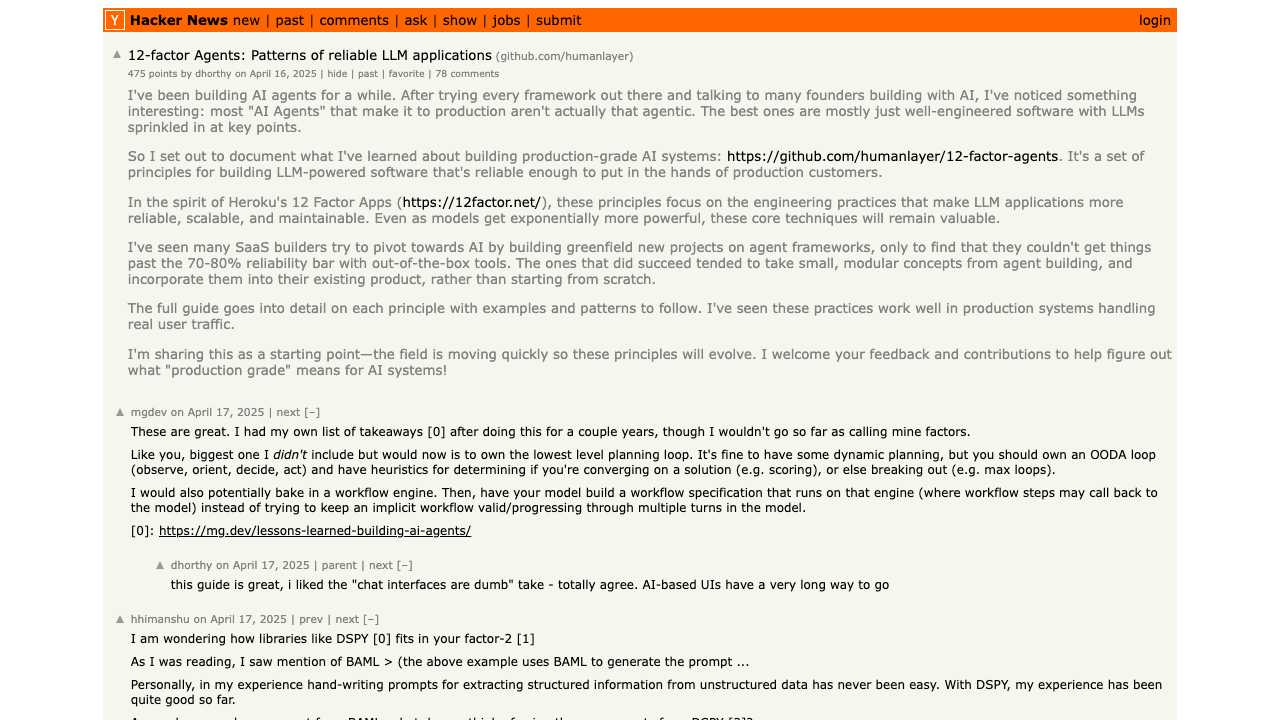 Hacker News: 12-factor AgentsThe launch discussion on whether production agents need new frameworks or solid software design with model calls placed where they add value.
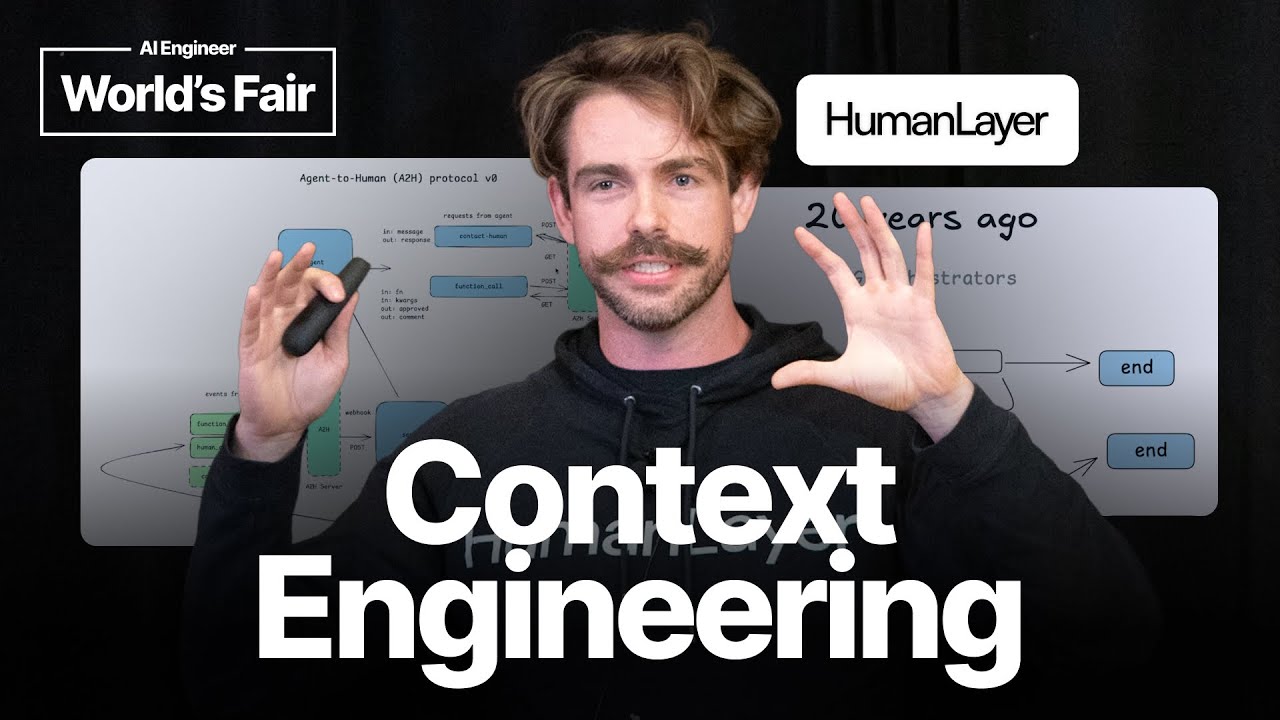 12-Factor Agents: Patterns of Reliable LLM ApplicationsThe conference talk that brought the guide's production patterns—and context engineering—to a much wider audience.